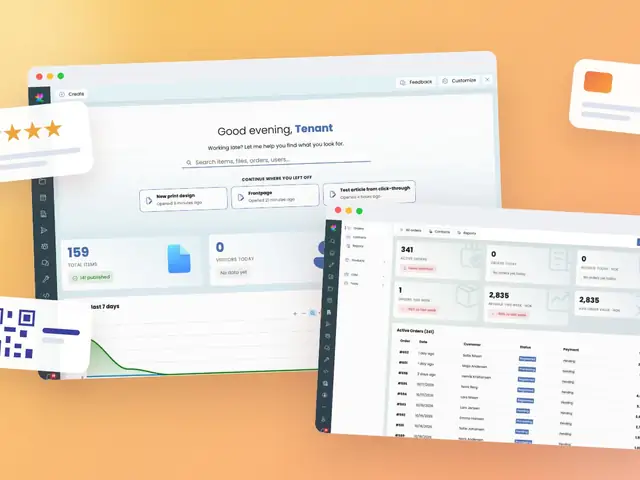
Here's a question worth asking about any platform you run your business on: when you sell a physical product, sell an event ticket, and take a room booking — are those really three different systems pretending to be one?
In a lot of platforms, yes. Behind the friendly interface, there are three separate transaction tables, three separate reports, three separate places customer history can hide.
In ExireNexus, there's just one.
Whether a customer buys a t-shirt, purchases a ticket to your summer event, or books a cabin for the weekend, it becomes an order with one or more order items. The order carries the same information no matter what was sold:
And each line item flexibly links to whatever was actually sold: a Product for a physical or digital item, an Item for content tied to the purchase, or an Event when the purchase is really a booking. One order can even mix these — a customer buying a product and booking a room in the same transaction, on the same invoice.
Think about what this replaces: no more jumping between "the shop reports" and "the bookings reports" to understand a customer's full relationship with your business. No more explaining to a new staff member why room bookings work completely differently from product sales in the back office. It's one order list, one search, one export — and everything shows up there, regardless of what kind of thing was actually purchased.
It also means new features tend to arrive "for free." Recurring billing, for instance — built once on ShopOrder — works for subscription products and for anything else built the same way, rather than being bolted onto just one part of the system.
Selling a subscription or a membership isn't an afterthought here — it's a first-class part of the order model. A ShopOrder can track its own recurring interval, next and last payment dates, and its linked Vipps agreement, so subscription billing runs through the same Vipps Recurring integration mentioned in our e-commerce post, without needing a separate billing system bolted on the side.
Every business tracks a few things its own way, and ExireNexus doesn't fight that. Alongside the standard fields, each order has flexible custom fields — text, numeric, and boolean — plus three customizable status fields. That means you can track things like "requires signature," "assigned to warehouse team," or "deposit collected" without needing a developer to add a database column every time your process evolves.
There's also room for the practical realities of running a shop: confirmation and shipping-notification tracking so you never accidentally email a customer twice, external order and payment IDs for syncing with accounting or fulfillment systems, and archive/soft-delete flags so old orders can be tidied away without ever truly being lost.
This is the same principle running through every part of ExireNexus: rather than a different system for every kind of "thing that gets sold," there's one well-designed transaction model flexible enough to represent all of them. A product sale, a ticket, a booking, and a subscription payment all end up looking the same to you — one list, one report, one customer history — even though under the hood they're doing genuinely different jobs.
Combine that with the MCP Server from earlier in this series, and even reporting becomes conversational: "How many orders came in last week, and how many were room bookings?" is a question the same order model can answer directly.